
Tolerances: what a twentieth of a millimetre buys you
Precision is not a number on a drawing - it is the difference between a lid that glides shut and one you learn to slam. A short tour of where the money in a machined object actually goes.
Pick up two objects that look identical. One feels expensive and one feels cheap, and you cannot say why. Nine times out of ten, the answer is tolerance: how far each surface was allowed to wander from where the drawing said it should be.
The band, not the number
No machine cuts a part at exactly 12.00 mm. Every dimension is really a band - a nominal value with an allowance either side - and the drawing's job is to say how wide that band may be.
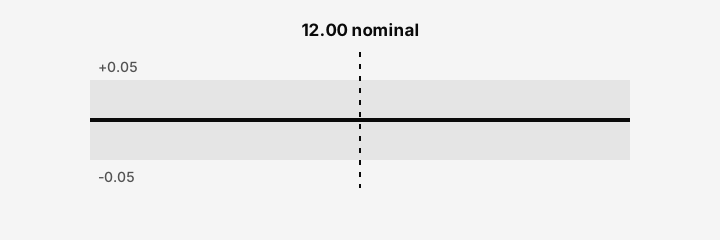
A garden-variety part lives at ±0.2 mm. A good consumer product holds ±0.1. The fits you can feel - a cap that floats onto its body, a tray insert that drops in with a soft cushion of air - start around ±0.05, a twentieth of a millimetre, half the thickness of a human hair.
Why tighter costs more
The band does not narrow for free. Each halving of the tolerance means some combination of:
- Slower cuts - less deflection, less heat, less spring-back.
- Better tooling - sharp inserts, rigid fixtures, warmed-up spindles.
- More measurement - a part is only as accurate as the instrument that checked it.
- More scrap - a narrower band rejects more of the natural spread.
That is the real cost curve of "it just feels nice": not exotic materials, but discipline repeated on every surface that touches another surface.
Where we spend it
The honest trick of good design is knowing where the band matters. A decorative outer face can live at ±0.1 and no hand will ever know. A sliding fit, a press fit, a thread, a magnet pocket - those get the twentieth of a millimetre. Tolerance is a budget, and objects feel expensive when it is spent exactly where fingers will find it.
Precision you cannot feel is waste. Precision you can feel is the product.